


 NIH Grants and Funding




Alternatives and NAMs
The 3Rs (replacement, reduction, and refinement) are foundational principles in responsible animal use. In particular, the consideration of alternatives such as new approach methodologies (NAMs) where scientifically appropriate, is important to ensure the judicious use of animals. The choice of model used in a study, animal or otherwise, is reviewed by the subject matter experts during the process of grant application or contract proposal. Because of this, OLAW does not advise on the applicability or implementation of a particular alternative model in a study. However, the resources here are intended to give biomedical researchers and IACUC members a place to start when learning about the 3Rs and NAMs, as well as resources for how to incorporate them into their work.
On this page:

Recent NIH Announcements
Note: Please refer to https://grants.nih.gov/ for the most recent information and related funding details.

I'm Curious About...
- What NAMs are and how does OLAW fit into NAMs use? "See the What are NAMs?" section below
- What NIH is doing in the NAMs space? Check out the Complement-ARIE program and NIH's Standardized Organoid Modeling (SOM) Center! NIH is also a part of the interagency committee ICCVAM.
- What IACUCs are responsible for when it comes to NAMs? See the "Tips for Investigators and IACUCs" section below.
- Who oversees NAMs in grants and contracts? As OLAW provides guidance regarding the administration of the PHS Policy, which applies to live, vertebrate animal use, questions regarding NAMs in grants and contracts should be directed to individual Institutes and Centers.
- Where can I find NAMs funding or training? Check out the "Resources for Investigators and IACUCs" section under Quick References below.
- How do I make a media inquiry regarding NAMs at NIH? Visit the NIH Grants and Funding Information for Media and the Public webpage for contact information.
Quick References
External resources are provided as a courtesy and their listing does not imply content control or endorsement by NIH. Please email suggested resources to the OLAW Division of Policy and Education. Commercial entities are not eligible for listing.
Resources for Investigators and IACUCs
Funding Opportunities Involving NAMs:
Note that some funding opportunities on linked sites may be external to NIH.
- NIH Funding: As of July 7, 2025, NIH will no longer issue Notices of Funding Opportuntities (NOFOs) exclusively supporting animal models or limit/specify the types of models that must be used. The intent of this effort is to ensure investigators consider the models most appropriate for understanding human states of health and disease and are not constrained by the NOFO. NIH will continue to support grants that use laboratory animal models if scientifically appropriate, justifiable, and with proper animal welfare oversight. You can find a list of current NIH funding opportunities here: Search for NIH Funding Opportunities.
See also: Updates to Finding NIH Funding Opportunities and Information, How Does the NIH Initiative to Prioritize Human-Based Research Affect Research Proposing the Use of Laboratory Animals?, and NIH Funding Announcements to Align with NIH Initiative to Prioritize Human-based Research. - Complement-ARIE Funding Opportunities page
- FNIH Call for NAMs Pilot Projects
- National Agricultural Library's 3Rs Funding Opportunities list
Literature Search Resources
- USDA Animal Welfare Information Center (AWIC) Resources for Alternatives Literature Searching
- National Toxicology Program Interagency Center for the Evaluation of Alternative Toxocological Methods (NICEATM) ALTBIB- Alternatives to Animal Testing literature search tool
- NORECOPA PREPARE Guidelines
Education and Training:
- NIH Standardized Organoid Modeling (SOM) Center
- NIH When Are Alternatives to Animals Used in Research webpage
- USDA AWIC Animal Use Alternatives webpage
- Annual 3Rs Symposium: Presentations on cutting-edge research involving NAMs and the 3Rs, as well as discussion of practical strategies for implementation. Be sure to register for the current year symposium! You can also access past symposia on the USDA National Agricultral Library's Animal Use Alternatives website.
- EPA New Approach Methods: Efforts to Reduce Use of Vertebrate Animals in Chemical Testing
- EPA Catalog of NAMS Training Materials
- EPA NAMs Conferences
- FDA Advancing Alternative Methods at FDA
- The 3Rs Collaborative
- The 3Rs Collaborative Species-Specific Refinement Resources
- NC3Rs
- NICEATM Alternative Methods resources
- NORECOPA 3Rs Resources
- RE-Place: Alternative Methods to Animal Testing resources
- USDA AWIC alternatives workshops (live and on-demand)
- NICEATM and ICCVAM Meetings, Workshops, and Webinars
- Johns Hopkins University Center for Alternatives to Animal Testing
- Society of Environmental Toxicology and Chemistry (SETAC) New Approach Methodologies
- Journal of Alternatives to Animal Experimentation
Selected Workshops from the National Academies of Science (NAS):
- New Approach Methods (NAMs) for Human Health Risk Assessment | Workshop 2 (May 12, 2022)
- New Approach Methods (NAMs) for Human Health Risk Assessment | Workshop 1 (December 9, 2021
- Microphysiological Systems: Bridging Human and Animal Research - A Workshop (January 19-20, 2021)
Resources for Students and the Public
You can learn more about how the NIH approaches animal use and NAMs by visiting the NIH Animals in Research web series. These pages discuss why animals are used in research, how animals have helped improve public health, how NIH ensures the care of animals used in research, when alternatives are used in research, and more!
Visit the NIH's Complement Animal Research In Experimentation (Complement-ARIE) Program webpage to learn about current initiatives to promote alternatives. The Interagency Coordinating Committee on the Validation of Alternative Methods (ICCVAM) is also a part of the NIH's National Institute of Environmental Health Sciences (NIEHS).
Tips for Investigators and IACUCs
While the concept of seeking alternatives is not new, recent advances in technology have made them more available than ever before! Here are some tips and reminders of existing guidance to help you as you think about how alternatives can be incorporated into your work or the work at your institution. Remember that "alternatives" can include strategies that reduce animal use overall, improve animal welfare over an existing practice, or in some cases serve as a complete replacement for animals.
For Investigators
- Start early! As soon as you have an idea for a grant or contract submission, start identifying relevant refinements or NAMs to consider. Similarly, seek statistical help early in the design phase of your project to ensure that your plan uses the fewest animals possible.
- Prepare a thorough VAS. Part of the grant application or contract proposal will include elements of a Vertebrate Animals Section (VAS), which requires discussion of replacement alternatives, refinements, and measures to reduce animal use. Ensure that this section is robust and reflects the most current scientific knowledge.
- Make time. Doing things a new way may take a modest up-front investment in time to implement, but they yield tremendous rewards.
- Plan ahead for additional training. Consider what resources you may need to become familiar with the refinement or novel method you are considering.
- Reach out to other experts. In particular, NAMs developers or scientists working on in vitro, in silico, or in chemico systems that could be useful in your area may not frequent the same conferences, publish in the same journals, or have the same contacts as those in your field.
- Embrace pilot projects! Pilot projects can be a great way to begin introducing new strategies into your work.
For IACUCs
- IACUCs are not responsible for work that exclusively involves humans and human biomaterials. However, they are responsible for reviewing animal activities and for the animal program under the PHS Policy.
- IACUCs have the ability to raise questions about both animal welfare and scientific merit (including questions regarding the 3Rs and NAMs) as it relates to animal use during the review of a project at the institution. FAQ D.12 provides more information on this ability and how it fits in with the role of the Scientific Review Group that reviews the grant or contract proposal. In addition, the Guide (p. 26) states, "While the responsibility for scientific merit review normally lies outside the IACUC, the committee members should evaluate scientific elements of the protocol as they relate to the welfare and use of the animals." IACUCs should also consider the U.S. Government Principles, which discuss appropriate model selection, utility, alternatives, etc.
- The PHS Policy (IV.C.3) allows for IACUCs to "invite consultants to assist in the review of complex issues" during protocol review. Consultants do not need to be IACUC members or members of the institution. Just remember that consultants "may not approve or withhold approval of an activity or vote with the IACUC unless they are also members of the IACUC."
- IACUCs remain responsible for ensuring that all animal users are appropriately trained, qualified, and experienced. This includes when new technologies or procedures are used in work with animals. (See FAQ G.1)
- Institutions are required to have an occupational health program "for personnel who work in laboratory animal facilities or [who] have frequent contact with animals" (PHS Policy IV.A.1.f). All procedures used in laboratory animal facilities or animal activities are included in this requirement.
- Investigators using custom in-vitro systems involving animal tissues may be subject to the PHS Policy, even if they do not use live animals. This depends largely on how and why the animal tissues were procured for the custom request (similar to the scenario posed in FAQ A.2). Please contact OLAW if you have questions regarding this situation.

What are NAMs?
The methods featured on this page fall into the categories of in vitro, in chemico, or in silico models. These involve testing methods that utilize human tissues, microphysiological systems (MPS), benchtop laboratory equipment, computer simulations, artificial intelligence (AI), or similar approaches to explore scientific questions without the use of a living organism. Some approaches, called "combinatorial" approaches, utilize multiple methods. "NAMs" is an acronym that serves as an umbrella of many similar terms for these same concepts. Some of the various definitions across agencies and nongovernmental groups have included:
- New Approach Methodologies
- Non-Animal Models
- Novel Alternative Methods
...and many more!
The U.S. Government Principles, which are incorporated into the PHS Policy, state that "[p]rocedures involving animals should be designed and performed with due consideration of their relevance to human or animal health, the advancement of knowledge, or the good of society." (Principle II) Further, they clarify that "[t]he animals selected for a procedure should be of an appropriate species and quality and the minimum number required to obtain valid results. Methods such as mathematical models, computer simulation, and in vitro biological systems should be considered." (Principle III) The use of alternatives in translatable research, where scientifically appropriate, has been a core principle of animal use for a long time. The consideration of alternatives to replace animal models is one of three core principles of responsible animal use called the 3Rs. They include:
- Replacement: Use of alternatives to animal models
- Reduction: Use of methods that allow for fewer animals to be used.
- Refinement: Use of methods that improve animal welfare by minimizing pain and distress
The concepts underlying these 3Rs have been incorporated into the Guide for the Care and Use of Laboratory Animals (first published with NIH support in 1963) and the PHS Policy from the earliest stages. Sometimes "NAMs" is used interchangeably with the term "alternatives" in the context of complete replacement of an animal model. However, it is important to remember that NAMs are not the only alternatives in biomedical research. Alternatives that reduce animal use, refine established procedures, and elevate animal welfare in existing practices are also part of responsible animal use.
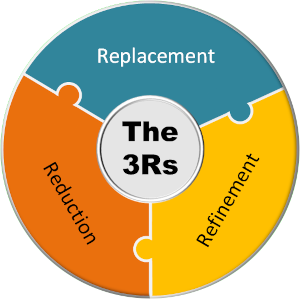
The 3Rs: Replacement, Reduction, and Refinement
While not every scientific question can be answered by using NAMs, these new technologies can be very useful in some specific applications. In a press release on July 18, 2025, NIH noted that " [r]esearchers may choose any model they deem appropriate – including a combination of approaches – to answer a research question when submitting applications seeking NIH support. This strategy is intended to open the possibilities of which types of models can be submitted in response to funding opportunities, not be restrictive or prescriptive." Regardless of the method used, whether in vivo or not, it is important that the research method be appropriate and yield relevant, translatable, and reproducible results. Fit-for-purpose use of NAMs is also in keeping with mandate in the U.S. Government Principles (Principle IV) that "[p]roper use of animals, including the avoidance or minimization of discomfort, distress, and pain when consistent with sound scientific practices, is imperative." The NIH Complement-ARIE Program is actively working to support the development and standardization of NAMs, and you can learn more about the initiative by clicking the button below:
OLAW's Role in Alternatives to Animal Use
While its primary focus is to administer the PHS Policy, OLAW participates in many NAMs initiatives both within and outside NIH to help foster collaboration and education on these methods. However, because OLAW does not make funding decisions or participate in scientific review of grants and contracts, it cannot advise on questions regarding the choice of model used for a specific project. The scientific, technical, and administrative specifics of a particular method are best answered by individual agencies, centers, and subject matter experts that can provide more detailed information. OLAW's mandate is to ensure the humane care of animals when they are used by "provid[ing] guidance and interpretation of the Public Health Service (PHS) Policy on Humane Care and Use of Laboratory Animals (Policy), support[ing] educational programs, and monitor[ing] compliance with the Policy by Assured institutions and PHS funding components... thereby contributing to the quality of PHS-supported activities." (OLAW Mission Statement). OLAW may consult on VAS review as requested and also provides education for investigators and members of the research program that supports alternatives and the 3Rs, including webinars and collaborative workshops such as the annual 3Rs Symposium, which includes cutting-edge NAMs content. A list of recorded OLAW webinars on 3Rs topics can be found below in the "Additional Resources" section.
Laws, Policies, and Guidance
PHS Policy Section I- Introduction: "The PHS endorses the "U.S. Government Principles for the Utilization and Care of Vertebrate Animals Used in Testing, Research, and Training" developed by the Interagency Research Animal Committee. This Policy is intended to implement and supplement those Principles."
The U.S Government Principles state the following:
- Principle II: "Procedures involving animals should be designed and performed with due consideration of their relevance to human or animal health, the advancement of knowledge, or the good of society."
- Principle III: "The animals selected for a procedure should be of an appropriate species and quality and the minimum number required to obtain valid results. Methods such as mathematical models, computer simulation, and in vitro biological systems should be considered."
- Principle IV: "Proper use of animals, including the avoidance or minimization of discomfort, distress, and pain when consistent with sound scientific practices, is imperative..."
NIH Grants Policy Statement 4.1.1 Animal Welfare Requirements: "Applications from organizations proposing the use of animals are incomplete if they do not thoroughly address the use of vertebrate animals required in the Research Plan of the application." This includes information required by the Vertebrate Animals Statement (VAS).
Health and Human Services Acquisition Regulation (HHSAR) 370.401.c: " If using live vertebrate animals, HHS policy requires that offerors address the points in the Vertebrate Animal Section (VAS) of the Technical Proposal. Each of the points must be addressed in the VAS portion of the Technical Proposal."
NOT-OD-25-163- Updated NIH Policy on Allowable Costs for Animals: "This notice alerts the extramural research community of updates to the NIH Grants Policy Statement 7.9.1, Selected Items of Cost. Effective October 1, 2025, NIH will allow recipients to charge costs for rehoming/retirement of experimental animals."
NOT-OD-26-007- Reminder of Compliance Requirements for NIH Extramural Recipients Related to Renegotiated Aims, Objectives, Titles, and Abstracts: "NIH seeks to remind awardees that all changes in scope that were agreed upon by NIH and the Authorized Organizational Representatives (AOR) become new terms and conditions of award, and the recipient must comply with those changes. This includes changes in scope that were renegotiated to align with the agency’s priorities. As such, NIH fully expects recipients to comply with the new terms and conditions, unless otherwise stated in the Notice of Award, or unless NIH has been enjoined by court order from imposing or enforcing such terms while that court order is in effect."

Additional Resources


OLAW Webinars
| Change Management in Animal Research | June 27, 2024 |
| Improving Experimental Design: Ethical Implications and How the Experimental Design Assistant (EDA) Can Help | September 14, 2023 |
| The ARRIVE 2.0 Essential 10: Guidance for NIH-sponsored Research | June 15, 2023 |
| Best Practices for Conducting a Search for Alternatives and Finding Animal Model/Model Organism Information | December 9, 2021 |
| Balancing Public Interests, Benefits, and Risks in Animal Research | June 9, 2016 |
| Resources for the 3Rs | September 24, 2015 |
| Meeting Requirements for Alternatives Searches | June 26, 2014 |
| Ethics and IACUC Responsibility | June 10, 2010 |

Related Articles and Reports
Note: This section is provided for convenience only and is not intended to catalog all NAMs-related literature.
| FDA | FDA Releases Draft Guidance on Alternatives to Animal Testing in Drug Development | March 18, 2026 |
| NC3Rs | Incorporating New Approach Methodologies in the Development of New Medicines | September 2025 |
| FDA | Roadmap to Reducing Animal Testing in Preclinical Safety Studies | April 10, 2025 |
| AAALAC International | Position Statement on the 3Rs | October 2024 |
| Complement-ARIE | Landscape Analysis Report 2024: New Approach Methodologies in Biomedical Research | February 2024 |
| NIH | Report to the Advisory Committee to the Director: Catalyzing the Development and Use of Novel Alternative Methods | December 14, 2023 |
| EPA | EPA New Approach Methods Work Plan: Reducing Use of Vertebrate Animals in Chemical Testing | December 2021 |
| ICCVAM | A Strategic Roadmap for Establishing New Approaches to Evaluate the Safety of Chemicals and Medical Products in the United States | January 2018 |